
How To Get More Light, Even In The Winter Months
Oct 29, 2026How to get more light, even in the winter months
Sunlight is a key nutrient for optimal health. At this point, it’s well established how many hormones, neurotransmitters, and key biochemical pathways rely on properly timed light signals to function optimally. From gastrointestinal disorders to seasonal affective disorder, sunshine, or lack thereof, plays a role in both the development and remission of many common modern illnesses.
Vitamin D, a pro-hormone and key nutrient, is acquired mainly from sun exposure on the skin. Vitamin D deficiency, which is widespread in our modern society, can be linked to many illnesses, from autoimmune diseases to mood disturbances.
From an anecdotal and personal point of view, I have always adored the sunshine. Summer is, has always been, and will always be my favorite season. I don’t even mind dripping in sweat. The sun just makes me feel good from the inside out. While I don’t cover myself in cheap hair spray for a suntan, I will still regularly try and sunbathe (covering my head and chest, mainly for aesthetic reasons) a few times per week during the summertime to naturally raise my vitamin D levels. I cite sunshine as one of the main contributors to my healing from mold toxicity a few years ago.
I remember lying outside in the chilly spring air and I would envision that sunshine was permeating from every cell in my body. That I was literally glowing from the inside out. I would daydream that I was so alive with light inside of my body (which is true, we make biophotons in our cells) that no dark-and-dampness-loving mold could ever survive inside of my body. They simply weren’t welcome there any longer.
Now, certainly there were herbal supplements, green juices, sauna, binders, walking, remediating the home environment, and a host of other interventions that I used, but when I look back, I recall sunshine being one of the biggest factors.
Light begets light in the human biology story. Sunlight on our skin and in our eyes leads to a cascade of beneficial dominoes toppling - one after the other - and this helps our own cells (aka mitochondria inside of the cells) to make more light. Light from light.
Further evidence of my love affair with sunlight can be seen in how all of the food we eat is essentially packaged sunlight. Think of it. The sun shines down on the plants. The plants store up the energy from the sun along with nutrients from the ground and water and CO2 and it creates sugar molecules. Then animals come along and eat the plants. We eat the animals and the plants and our bodies effectively unpack sunlight energy. It’s a true marvel.
To ever think it’s something that should be blocked or avoided has always seemed counterintuitive and unnatural to me. Again, this is my wonder-filled brain, but I love that my intuition is now science-backed.
So this is step one: convince the patients, or perhaps remind them (their childhood selves undoubtedly knew that sunlight was good), that sunlight is a key nutrient. And like any nutrient, we must have balance. Not too little, not too much.
And once I am able to convey the importance of sunlight to patients, the next phase is to help them figure out how to get more sunlight in their lives.
This is especially easy in the summertime months, but as winter approaches, getting adequate sunlight can seem tricky or even impossible.
Here are a few principles and ideas to help promote sunlight in the colder months:
1. Get outside every morning for at least 5 minutes, regardless of the weather.
This is typically easier if you have a covered porch or patio in case of rain, but most people I speak with have a covered area where they can step outside shortly after waking up. Getting at least 5 minutes of sunlight around sunrise will help regulate cortisol, insulin, melatonin, and a whole host of other hormones. It will help you feel awake, alert, and even help regulate your appetite.
If it’s colder, put on a robe. Put on sweatpants. Put on slippers. Regardless of how you get outside, just get outside! Fresh air is good for you.
2. Get morning sunlight with “naked eyes”
The idea is that you get outside around sunrise without contact lenses, glasses, or sunglasses. The wavelengths of light will then stimulate the visual pathways that lead to your brain and hormonal control centers. If you have on sunglasses, the signals will be diminished or absent.
3. Create a morning routine
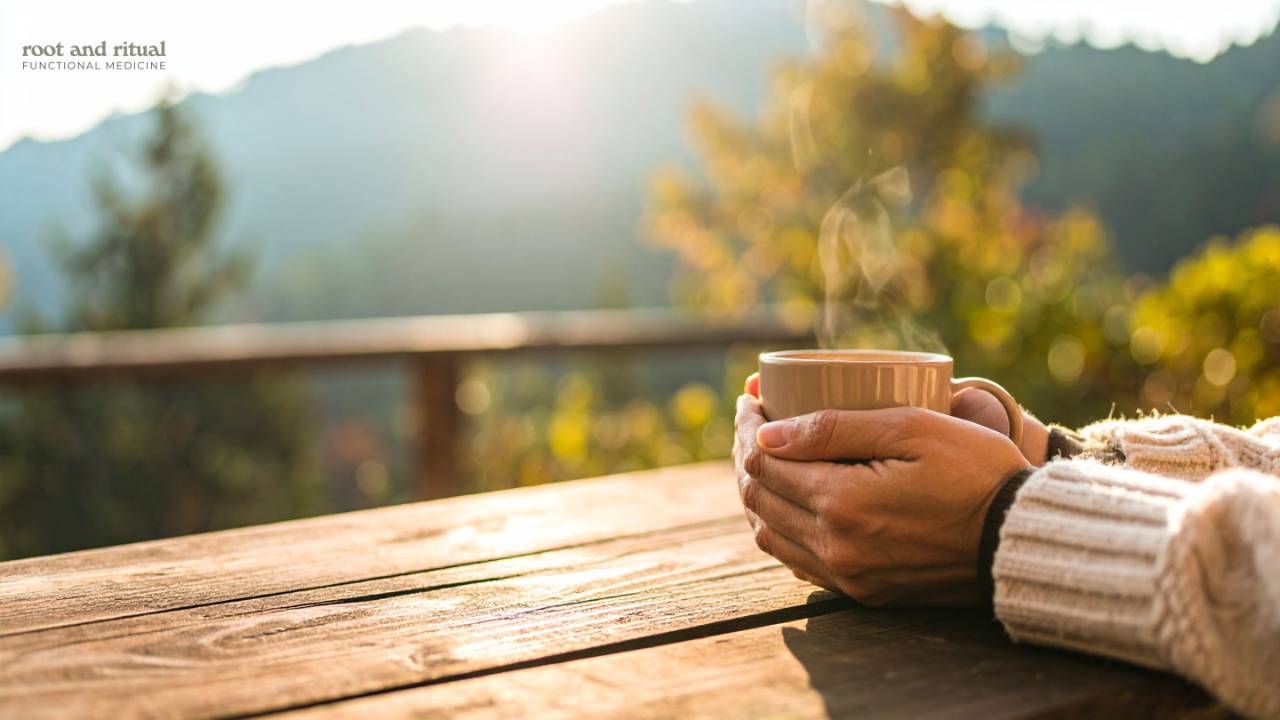
I wake up, go to the bathroom, and then I get the dog and take her outside while I step onto the grass. I try and do this every morning, nearly 365 days a year. If it’s really pouring down outside, I’ll avoid the extra shower. But otherwise, it’s just a habit at this point. Sometimes, I’ll put water on to boil before going outside. Multi-tasking at its finest. My reward for my morning routine is a warm mug of matcha tea.
When my kids wake up or when I wake them up, I immediately encourage them to go outside as well. When they were little, I would say to them, “Let’s go outside and say ‘Good morning, world!’” But now that they’re a bit older, I encourage them to get their “morning eyes,” as Carrie Bennett says.
4. “Never be within doors when you can rightly be without.” - Charlotte Mason
As you go about your day, consider how you could spend more time outdoors.
Can you take that phone call outside? Can you work on your laptop outdoors? Can you enjoy your breakfast on the patio? What about a picnic? Let’s bring back the picnic! Surely, cold weather can hamper this, but in Virginia, we get the occasional 75 degree day in nearly every month, save perhaps January or February some years. Take advantage of good weather!
5. Wear the appropriate clothing
There is a popular Nordic saying, “there is no such thing as bad weather, only bad clothing.” Originally from Mississippi, I moved to Virginia when I was 23, and I unfortunately spent the next 15 years convinced that it was too cold for me here. Over time, I realized that it wasn’t the weather. Virginia weather is quite beautiful and only modestly chilly. It was my clothing choice! Once I purchased proper gloves, hats, boots, and a solid coat, then I came to thoroughly enjoy being outdoors year-round.
6. Pair movement with time outdoors
Fall and winter hiking can be really enjoyable, especially if you’re moving from the summer months where you’re quickly drenched in sweat. We humans are designed with a need for movement, especially continuous low-level movement. The exact kind of movement that hiking can provide.
I strongly recommend all my patients regularly get outdoors for a hike once a week. Not only are you getting natural sunlight, but forest bathing (aka hiking in the woods) has been shown in studies to strongly support a positive attitude and mental health overall. How is that for multi-tasking? Oh, and it’s free! Find a buddy. Check out AllTrails and get to hiking.
7. Enlist the help of a lamp
Seasonal affective disorder has been dubbed a sunlight deficiency state. And while natural sunlight contains both the brightness and the specific wavelengths of light required to help regulate your mood, the lamp at least can provide the brightness.
Sitting in front of a lamp, such as the Happy Lamp by Verilux, for 10-20 minutes in the morning can help improve your alertness and help improve your mood. This can be a lifesaver on chilly mornings where you don’t have much time to be outdoors or the weather is really poor.
8. Swap lightbulbs in key areas
Our modern indoor lighting does us zero favors when it comes to our hormones. In fact, it can actually disrupt the signals by confusing the body’s clocks. LED lights put out mainly blue wavelengths of light, and this creates chaos in the body’s timing mechanisms.
By swapping out your LED bulbs for less energy efficient incandescent bulbs, you can at least bring back supportive red wavelengths of light and minimize the spike of blue light. I like Health Lighting and have swapped bulbs in my office, living room, and bedroom lights.
Well, there you have it! A smattering of tips to help you get more light in your life, even during the winter months.
My hope is that this article will inspire you to get outdoors, no matter the season.
